
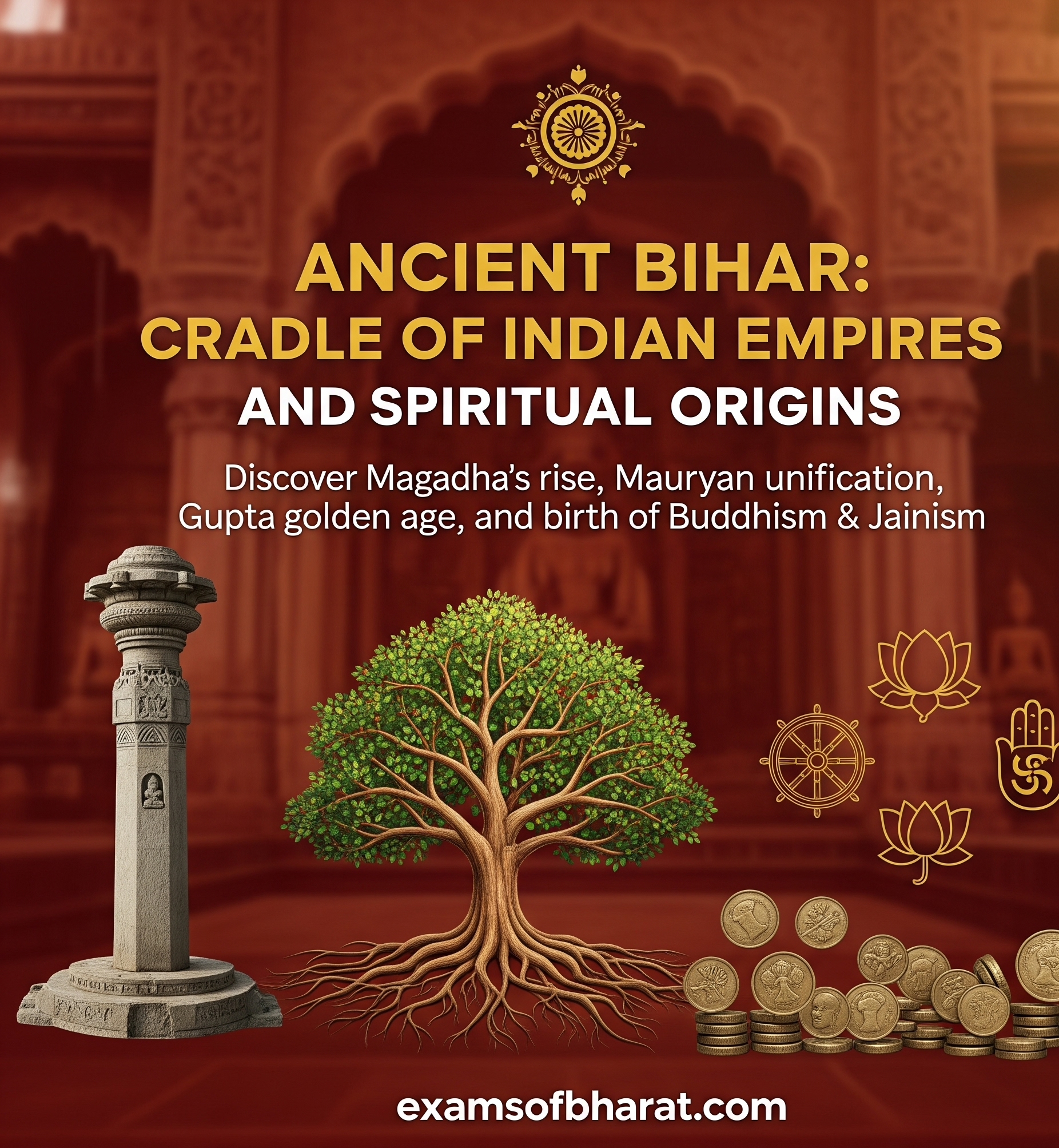
Ancient History of Bihar: The Rise of Magadha, Mauryan and Gupta Dynasties, Buddhism and Jainism
The Magadha Empire: Cradle of Ancient Indian Power
Magadha, located in present-day Bihar, was a foundational region in ancient Indian history, serving as the center of power, learning, and culture for nearly a millennium. It rose to prominence between the 6th and 4th centuries BCE, occupying a strategic location near the Ganges River. This fertile region supported the growth of powerful monarchies that laid the groundwork for future empires. One of the earliest powerful rulers was King Bimbisara, who expanded Magadha’s territory and established its capital at Rajagriha. This city later shifted to Pataliputra (near modern Patna), which became an important political, military, and economic hub.
Magadha played a critical role in the political unification of much of the Indian subcontinent and is famed for nurturing some of India's most illustrious empires. The rise of Magadha is also closely intertwined with the emergence of two major religions: Buddhism and Jainism, both of which espoused principles of non-violence and ethical living, challenging the rigid Brahmanical order of the time. The kingdom’s significance is reflected in numerous ancient Indian texts, epics, and plays such as Abhijñānaśākuntala. The region's influence extended well beyond its boundaries, shaping Indian civilization profoundly.
The Mauryan Dynasty: Unifying the Indian Subcontinent
The Maurya Empire, established by Chandragupta Maurya in the late 4th century BCE, marked an unprecedented period of political consolidation in ancient India. Originating from Magadha, the Mauryan dynasty expanded its reach across most of the Indian subcontinent. Under the guidance of Chandragupta and his grandson Ashoka the Great, the empire built a highly centralized administration and prospered through trade, agriculture, and military conquests.
Ashoka’s reign is particularly notable for his conversion to Buddhism after the bloody Kalinga War, leading to his promotion of Buddhist values such as compassion, non-violence, and tolerance. He propagated Buddhism through edicts inscribed on pillars and rocks across the empire and sent missionaries abroad. Pataliputra thrived as the imperial capital, fostering political stability and cultural advancements.
The Mauryan period is also celebrated for contributions to art, architecture, and culture, including stupas and rock-cut architecture, which remain vital archaeological heritage sites today.
The Gupta Empire: The Golden Age of India
The Gupta dynasty, emerging approximately five centuries after the Mauryas, heralded what is often called the 'Golden Age' of ancient India, broadly spanning the 4th to 6th centuries CE. Originating again in the Magadha region, the Guptas revitalized Indian culture, art, science, and political administration.
The Gupta rulers, such as Chandragupta I and Samudragupta, expanded their realm and promoted a period marked by advancements in astronomy, literature, metallurgy, and mathematics—most famously the concept of zero. Sanskrit literature flourished, including plays and poetry that are key cultural legacies.
During this era, the Hindu religion gained prominence, yet Buddhism and Jainism continued to coexist and influence society. The empire maintained a system of local governance and encouraged trade routes, aiding economic prosperity. The cultural and intellectual achievements of the Gupta period profoundly influenced subsequent generations and remain central to understanding India's historical trajectory.
The Rise of Buddhism and Jainism in Bihar
Bihar was the birthplace of two of India’s great spiritual traditions, Buddhism and Jainism, which emerged as responses to the prevailing social and religious order. Both religions emphasized ethical conduct, non-violence (ahimsa), and liberation from the cycle of rebirth.
Buddhism was founded by Siddhartha Gautama, the Buddha, around the 6th century BCE near Bodh Gaya, where he attained enlightenment beneath the Bodhi tree. The region became a pilgrimage center and a hub for Buddhist learning. Key sites such as Nalanda University later developed here, attracting scholars from across Asia.
Jainism, established by Mahavira, also in the 6th century BCE, emphasized strict asceticism and non-attachment. The religion’s followers played an important role in the cultural and moral fabric of ancient Bihar, influencing the region’s governance and society.
Both religions thrived under the patronage of rulers like Ashoka of the Mauryan dynasty, who actively supported Buddhist institutions while tolerating Jain traditions. Their teachings deeply shaped the ethical and philosophical discourse in Bihar and greatly impacted Indian civilization as a whole.